Science and Sufism were discussed at the Istiqlal Cultural Center in Jakarta
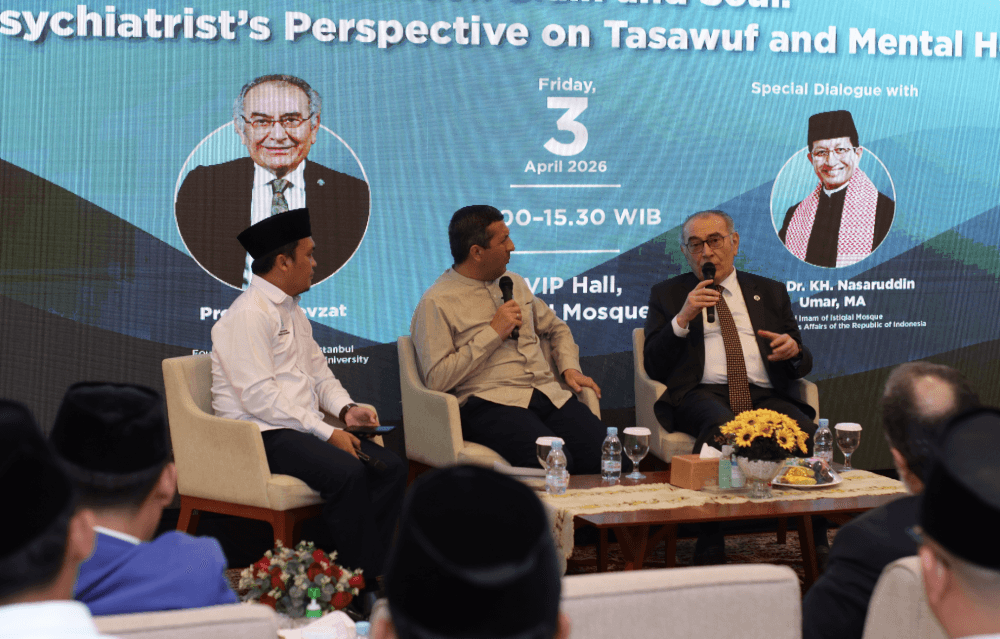
The Indonesia program of Üsküdar University Founding Rector Prof. Dr. Nevzat Tarhan continued on its second day at the Istiklal Cultural Center, one of Jakarta's iconic venues. In a talk titled "Between Brain and Soul: Sufism and Mental Health from a Psychiatrist's Perspective," Tarhan presented the healing prescriptions offered by Sufism from a scientific perspective.


Recitation of the Holy Quran and a whirling dervish performance…
The program at the Istiqlal Cultural Center, a symbol of Jakarta, began with a recitation of the Holy Quran.

The whirling dervish performance that followed transported the participants from thousands of kilometers away to the heart of Anatolia, to the atmosphere of Mevlana.

Education and culture were emphasized at the opening.
In the opening session of the program, İbrahim Albayrak, CEO of Edutolia Education, who made significant contributions to the realization of the organization, and Dr. Peyman Jaferi, Head of International Relations at Üsküdar University, each delivered a speech.
Albayrak and Jaferi emphasized that the educational bridges between Turkey and Indonesia are not only academic but also cultural and spiritual ties, and expressed their satisfaction with the contribution that Prof. Dr. Nevzat Tarhan's visit to Jakarta made to the scientific exchange between the two friendly countries.

Spiritual ties between the two brotherly countries are being strengthened.
In his speech at the program, Dr. Abdulhamit Eşmeli, Religious Affairs Counselor at the Turkish Embassy in Jakarta, emphasized that Sufi culture, a cornerstone of Islamic civilization, is a powerful refuge against the spiritual problems brought about by the modern age, and stated that such events strengthen the spiritual ties between the two brotherly countries.

Following the welcoming speeches, the event continued with a discussion titled “Between Brain and Soul: Sufism and Mental Health from a Psychiatrist's Perspective,” featuring Prof. Dr. Nevzat Tarhan as the speaker.
Prof. Dr. Nevzat Tarhan emphasized that each figure in the sky is a universal symbol, explaining that the right hand raised and the left hand lowered represent "receiving from God and giving to the people," and that the dervish is merely an intermediary and a means in this cycle.

A Sufi solution to the crisis of modernism.
Beginning his speech by addressing the spiritual dilemmas of the modern world, Tarhan stated that the root cause of the global increase in suicide, depression, and addiction cases over the past 40 years lies in a "pleasure-oriented philosophy of life." Comparing this egocentric mindset to a cancer cell in the body, Tarhan said: "A cancer cell knows no boundaries; it grows by devouring what is around it, but in the end, it kills both the body and itself. Mevlana's teachings, however, are the strongest shield protecting humanity from this trap of narcissism."

Modern humans are trapped in a life focused on consumption and pleasure.
Professor Dr. Nevzat Tarhan, who described "California Syndrome" as a spiritual pandemic of the modern age, dedicated a special section to this phenomenon, drawing attention to the dangers brought about by this Western-centric lifestyle. Analyzing the syndrome's four core symptoms – hedonism, narcissism, loneliness, and unhappiness – Tarhan stated, "Modern man, with California Syndrome, has been trapped in a life focused solely on consumption and pleasure. This situation leads the individual to profound loneliness amidst crowds and an endless search for meaning."
Tarhan emphasized that spiritual values are an important rehabilitation tool for modern people.
The reference point for positive psychology: Rumi and the PERMA Model.
Tarhan stated that Positive Psychology, which the Western world has presented as the "science of happiness" in recent years, is actually Mevlana's methodology, and explained the PERMA model using Sufi concepts.
Professor Dr. pointed out that 5 of the elements found in Seligman's PERMA Model, the latest theory in Positive Psychology, are also found in Sufism. Tarhan explained these points as follows: “The letters are P (positive emotion), E (engagement), R (relationships), M (meaning), and A (accomplishment). The first point is that a person should initially act with a positive perception in their life. What is this? In Sufism, it is said that every person can be a friend unless they see otherwise. They have taken this philosophy and processed it in positive psychology. The second is that a person should be engaged in work that makes them happy, that is, the state of being happy with small things. The equivalent of the word gratitude. Being able to be grateful for small things. The third point is establishing relationships, maintaining strong social ties, which corresponds to the concept of a friendly person in Sufism. The essence of Sufism is: are you looking for a friend who will help you? There are very few, but if you are looking for friends who need help, there are so many. Making doing good a method is the philosophy of the wisdom teaching. The fourth is meaningfulness, giving meaning to everything. One of the teachings of Sufi culture is that everything you do has meaning; even smiling is considered charity. We can now scientifically define a culture where even a smile is considered charity.” The fifth model is about savoring success. It's about being able to find pleasure in small achievements. The Western philosophy of always needing more is questioned here. Perma is missing one element; true happiness isn't only possible with happiness in this world, and this is a philosophy that only aims for happiness in this world," he said.

Four steps to the truth and a warning about fake sheikhs!
Tarhan, summarizing the journey to truth through the teachings of great figures like Imam Rabbani and Imam Naqshbandi, explained the stages of Sharia, Tariqa, Marifa, and Haqiqah. Stating that the greatest Tariqa in this era is following the Sunnah of the Prophet Muhammad, Tarhan also warned society against "false sheikhs" who exploit religion for commercial or worldly gain.
Sufi meditation with scientific data
Referring to Üsküdar University's scientific studies on the brain, Tarhan explained the neurobiological effects of spirituality with the following words: "Sufi meditation and dhikr activate the anterior cingulate cortex, the brain's emotion regulation center. Trusting in God and feeling oneness with Him releases dopamine and serotonin in the brain, providing a protective effect against depression."

Charity economy and social security
Tarhan stated that the Western world has moved from the capitalist era, where it viewed charity and mutual aid as cost-increasing, to the stage of "social responsibility," and emphasized that the culture of zakat and charity in Islam builds social trust. He highlighted the impact of Sufism on social welfare, saying, "Where there is trust, there is peace; where there is peace, there is production and tranquility."
Answering questions from the participants, Prof. Dr. Nevzat Tarhan also made noteworthy statements on male-female relationships and differences in brain structure from the perspective of Sufism and psychology.
The female and male brain: Differences and complementarities.
Professor Dr. Nevzat Tarhan, stating that understanding biological and psychological differences is fundamental to healthy communication in relationships, shared striking data on the functioning of the male and female brain. He emphasized that the emotional intelligence and empathy-focused "network" structure of the female brain, and the more results-oriented and "logical" functioning of the male brain, are not competing but complementary elements. Tarhan stated, "The relationship between men and women is not a competition for superiority, but a matter of balance and grace. Instead of the conflictual models imposed by the modern world, the principle of 'compassion and affection' offered by Sufism is the only way to bring peace to both lobes of the brain," adding that the key to peace within the family lies in accepting these inherent differences.

Indonesians showed great interest in author Tarhan on the second day as well.
At the end of the program, Prof. Dr. Nevzat Tarhan met with his readers amidst great interest. Indonesian readers, eager to have their books translated into Indonesian signed, formed long queues to take souvenir photos with Tarhan.


Updated At:13 Ağustos 2026