In modern times, Yunus is in Indonesia
The four-day program in Indonesia of Üsküdar University Founding Rector Prof. Dr. Nevzat Tarhan concluded with a talk titled "Spiritual Prescriptions for Contemporary Problems with Yunus Emre" held at the Yunus Emre Institute in Jakarta. Offering a broad perspective ranging from the founding philosophy of the Ottoman Empire to the digital impasses of modern psychiatry, Tarhan shared Yunus Emre's "language of the heart" with Indonesians, supported by scientific data.


Institute Director Dr. Cemal Şahin: "We are building a bridge of knowledge between two brotherly nations."
In his opening remarks, Dr. Cemal Şahin, Director of the Jakarta Yunus Emre Institute, expressed his pleasure in hosting Prof. Dr. Nevzat Tarhan and his team. Şahin emphasized that cultural ties between Turkey and Indonesia are further deepened through such scientific and spiritual gatherings, and stated that the students' enthusiastic participation was a testament to the brotherhood between the two countries.

From Mevlana to Yunus: The Builders of Civilization
Beginning his speech by drawing attention to the spiritual connection between Mevlana and Yunus Emre, Prof. Dr. Nevzat Tarhan stated that both figures lived in the same period and laid the intellectual foundations for the establishment of the Ottoman Empire. Tarhan said, "While Mevlana served among the scholars, Yunus Emre went among the people and conveyed the same wisdom to the common folk. The secret to the Ottoman Empire's bringing peace to the world for 600 years lies in the philosophy of these figures, centered on 'Ilay-i Kelimetullah' (the exaltation of God's word) and 'Divine Will'."

An in-depth analysis of Mevlana and Yunus's responses using artificial intelligence…
Tarhan began by thoroughly analyzing the AI's answers to questions such as, "If Mevlana and Yunus were alive today, what methods would they use? If we bring Yunus Emre to the present day, what approach would he take if he were alive in this era?"

The pandemic of the modern age: Loss of meaning and materialism.
Tarhan stated that the two greatest global enemies of today's world are materialism and atheism, adding that these movements lead humanity to a "loss of meaning." Referring to Bediüzzaman Said Nursi's observations on this subject, Tarhan emphasized, "It is a necessity to prove the truths of Islam with the scientific knowledge of this age. Today's Muslim should live holding science and technology in one hand and the Quran in the other."

Yunus Emre and psychiatry: "The Heart is the Throne of God"
Tarhan, who analyzed Yunus Emre's teachings from a psychiatric perspective, noted that Yunus's lines, "The heart is the throne of God / God looks upon the heart," perfectly align with the concepts of "self-awareness" and "the search for meaning" in modern psychology. Tarhan stated that modern medicine now accepts "spirituality" as a parameter for healing, and that Yunus Emre's teachings of simplicity and humility are the strongest antidote against the narcissism pandemic.

A fiery ordeal: Preserving faith in modern times.
Referring to the Prophet Muhammad's hadith about "our future brothers," Tarhan described the challenges facing today's youth with these words: "Living a religious life today is like holding fire in your hand. If you let go, you will leave the religion; if you don't let go, your hand will burn. In this time, a young person who has not been involved in major sins is like a saint of old. Being with God while remaining within society and being with the people is the greatest jihad of this time." 4
The world is a sea, and man is a ship.
Tarhan summarized Mevlana and Yunus's view of worldly possessions with this striking metaphor: "The love of the world is like a sea, and man is a ship sailing in it. You can sail in that sea as much as you want, but if you take that water (the love of the world) into the ship, you will sink. Let money, possessions, and property be in your pocket, but never in your heart."


Great interest from students and a book signing event.
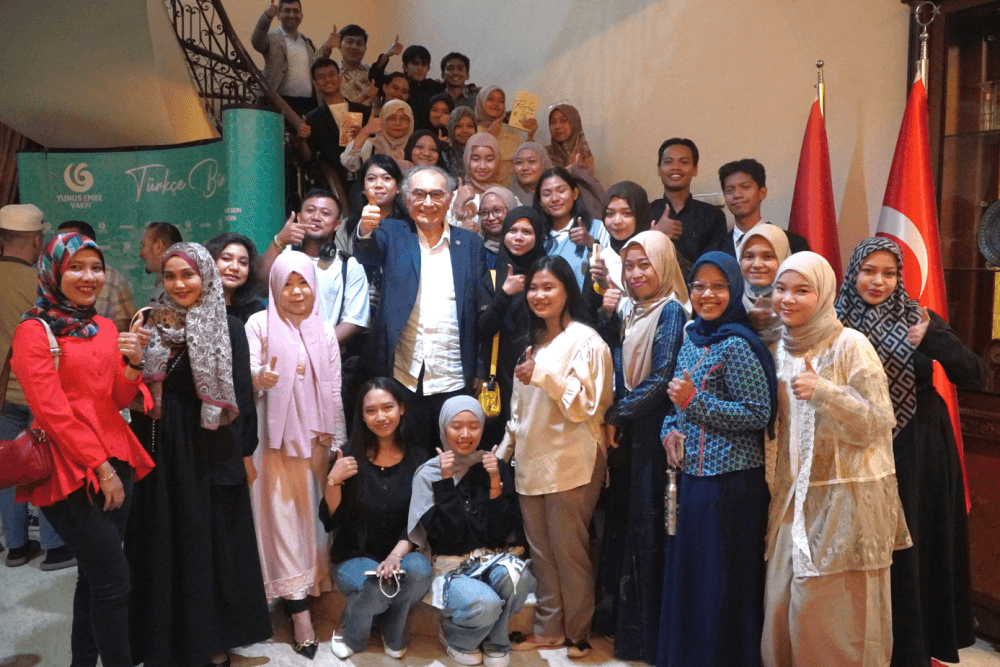
At the end of the program, which attracted the interest of Indonesian students and educators, Prof. Dr. Nevzat Tarhan spoke with his readers individually.
Tarhan, who signed copies of his works translated into Indonesian, posed for souvenir photos with the participants.
Tarhan, who sincerely answered the young people's questions, concluded his Jakarta program with this meaningful meeting.

A 4-day visit to Indonesia built a bridge of science and knowledge between cultures of shared values.
Üsküdar University Founding Rector Prof. Dr. Nevzat Tarhan's four-day program in Indonesia, ranging from academic diplomacy to spiritual encounters, was completed with intense interest and high-quality meetings at every stage.
From the strategic steps taken with the Jakarta Embassy and Paramadina University to the gatherings of thousands at the Istiklal Mosque and the Yunus Emre Institute, every stop has once again proven the universal power of Anatolian wisdom.
Tarhan, who synthesized the data of modern psychiatry with the teachings of Mevlana and Yunus Emre, not only made an academic contribution but also built a lasting bridge of friendship between Türkiye and Indonesia.
This program, which was met with great interest from Indonesian youth and the academic community, was recorded as a historic visit demonstrating the global manifestation of the 'Science and Wisdom' vision.

Updated At:13 Ağustos 2026